

water-lubricated oil-free screw air compressor quotation document
Water-lubricated oil-free screw design delivers high-purity air. Partner with a reliable air compressor manufacturer for a robust air compressor system.
View productSite conditions decide the configuration long before the model number does. Whether you are sourcing a portable air compressor for a mine heading, a tunnel face, a municipal breakdown or in-plant standby, the grid you can reach, the emission tier your market accepts and the chassis you can tow all come first. This playbook maps four site conditions to four configurations, and treats the air compressor portable decision as a site question before it becomes a specification question.
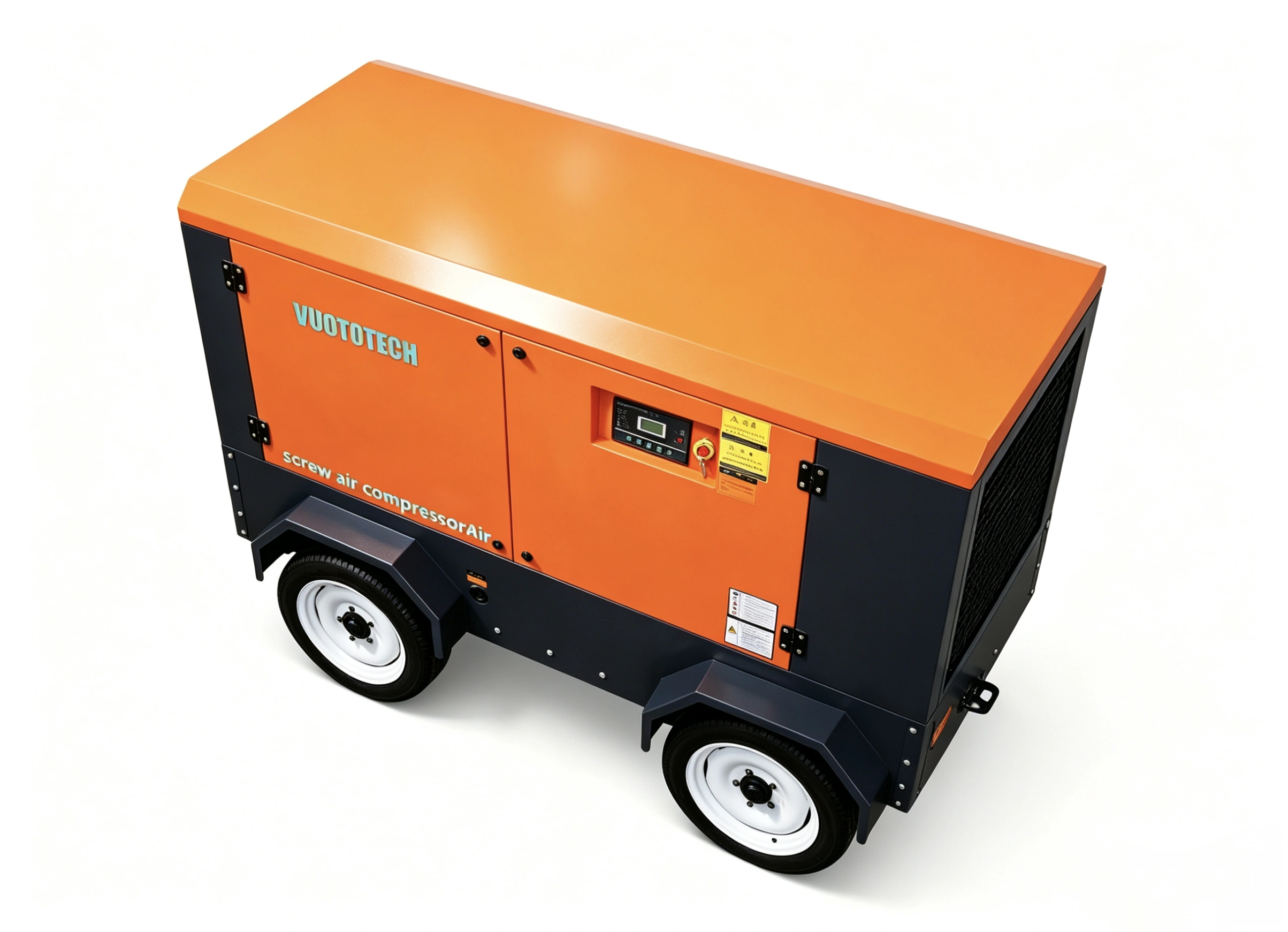
Read one row across and the column you belong in becomes clear. This is the filter you apply before the model, not a model list.
| Site constraint | Underground mining | Tunnel & section | Municipal & emergency | In-plant standby |
|---|---|---|---|---|
| Grid availability | Assume no usable supply at the face; diesel drive, or a dedicated electric supply run. | Electric mobile units need an external 380V/50Hz three-phase supply. | Usually none at short notice; diesel drive removes the question. | Plant supply is present — confirm 380V/50Hz three-phase capacity. |
| Explosion-proof / oil content | Specified as explosion-proof, with oil content in compressed air controllable below 3 ppm. | Confirm the section classification before assuming a standard unit is acceptable. | Confirm the site's own rules; it is rarely the governing factor. | Confirm the plant's classification where the unit sits indoors. |
| Mobility & towing | Chassis and retrieval path matter more than road speed. | Re-positioned as the face advances; towing speed up to 60 km/h on the listed model. | Towing speed, steering angle and turning radius decide the deployment. | Positioned once; the modular mobility design helps with installation and later moves. |
| Noise ceiling | Check the acoustic limit for the heading; screw units are listed at approx. 70–85 dB. | Check limits near portals and built-up approaches. | Night-work and residential limits often govern siting. | Plant-room adjacency is the usual constraint. |
| Emission tier by market | Diesel: Euro II, Euro III B or China IV, according to the market. | Electric drive avoids the question; diesel units still follow the market tier. | Match the tier before dispatch — municipal work is the most scrutinised. | Electric drive where the supply allows; otherwise the market tier applies. |
| Protection grade | Confirm the IP grade and enclosure against dust and washdown. | IP54 suits wet and dusty headings; IP23 suits dry plant conditions. | IP23 or IP54 depending on weather exposure at the works. | IP23 indoors, IP54 where dust or washdown is present. |
| Power band to shortlist | Sized from face demand, not from the 18.5–172 kW range itself. | Set by simultaneous tool count at the face. | Set by the repair, not by the site type. | Sized to the plant's peak pneumatic demand. |
Underground work organises the whole specification around two things: what the compressed air is allowed to contain, and how hard the unit is to retrieve when it needs service.
RequirementAn explosion-proof specification, with oil content in the compressed air controllable below 3 ppm, plus a diesel emission tier the market accepts.
ConfigurationExplosion-proof rotary screw unit; diesel drive to Euro II, Euro III B or China IV where there is no supply at the heading.
RequirementA long service interval and predictable consumable planning, so a retrieval is scheduled rather than forced.
ConfigurationScrew host with a stated maintenance interval of up to 80,000 hours, and 40,000–80,000 hours for the screw type.
RequirementA rugged chassis, a defined moving mode, and low noise and vibration at the working position.
ConfigurationSelectable 3- or 4-wheel chassis; the three-wheel diesel model is listed with any-angle steering, a moving speed of up to 60 km/h and a turning radius of 1.6 m.

No grid, no time, and city streets in between. On this site type the chassis and the fuel tank decide the specification far more often than the compressor head does.
Diesel-driven units for works without a stable electric grid. Emission tier is chosen for the market: Euro II or Euro III B.
3-wheel or 4-wheel, selectable. The three-wheel diesel model is listed with any-angle steering and a 1.6 m turning radius.
Moving speed listed up to 60 km/h, so the unit can follow a normal road route behind a service vehicle.
Average diesel consumption is listed at 4.1–9.3 L/h against 60 L and 90 L tanks, so refuelling is a shift-planning question.
Screw units are listed at approximately 70–85 dB; check any night-work or residential limit before siting.
Stable output flows and pressure levels for pneumatic tools and continuous medium-pressure use.

Planned outages are the easiest conditions to specify for: supply is stable, the position is fixed, and the only real variable is how much air the plant actually draws at peak.
RequirementConfirm 380V/50Hz three-phase capacity at the take-off point, and keep the unit out of fuel handling entirely.
ConfigurationElectric-driven unit on an external three-phase supply, with no local emissions at the operating position.
RequirementProtection matched to the room, and a noise level that does not dominate an adjoining working area.
ConfigurationIP23 for a dry plant room; IP54 where washdown, dust or moisture are present. Screw units are listed at approximately 70–85 dB.
RequirementService work that fits inside planned shutdowns, and a layout that can change as the plant does.
ConfigurationMaintenance interval stated at up to 80,000 hours, with the modular mobility design allowing repositioning as the layout changes.

The range runs from 18.5 kW to 172 kW with rated discharge pressures up to 1.7 MPa, so the shortlist is only as good as the site information behind it. Lead with the site and the numbers follow.
Drive type, chassis and explosion-proof specification are selected per project rather than added after the fact, and the product page also carries downloadable documents. Multi-unit and project-specific enquiries go through the same route.
Keep adjacent product options together for a faster catalog comparison.
Water-lubricated oil-free screw design delivers high-purity air. Partner with a reliable air compressor manufacturer for a robust air compressor system.
View product
Professional-grade micro-oil screw vacuum system offering precise control. Outperforms a standard rotary vane vacuum pump for efficient industrial applications.
View product
Featuring a modular design, this air compressor system provides contaminant-free, high-purity air. Partner with a top air compressor manufacturer and air compressor supplier for efficient…
View productReview the product details, images, and specifications presented on the official product page.
Use the application and use-case information published on the official product page.
Confirm the specifications and options listed for the exact product variant before placing an order.
Check the official product page or ask the supplier about options shown for the selected product.
Use the official contact or inquiry path provided on the site.
Include the product page, intended use, required quantity, and any specifications you need the supplier to review.
